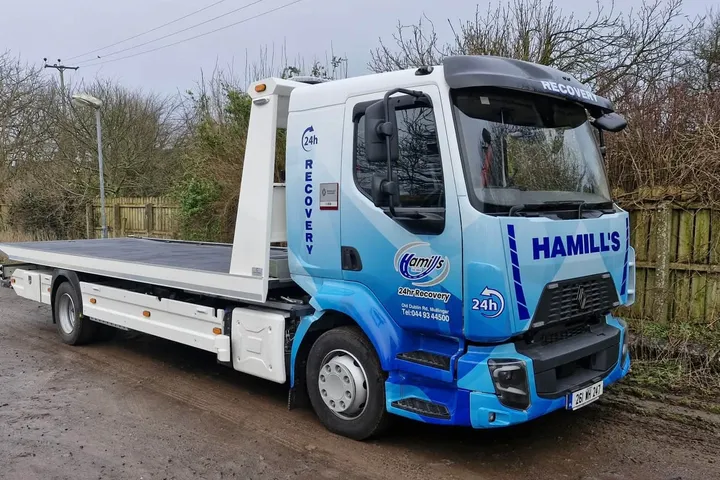
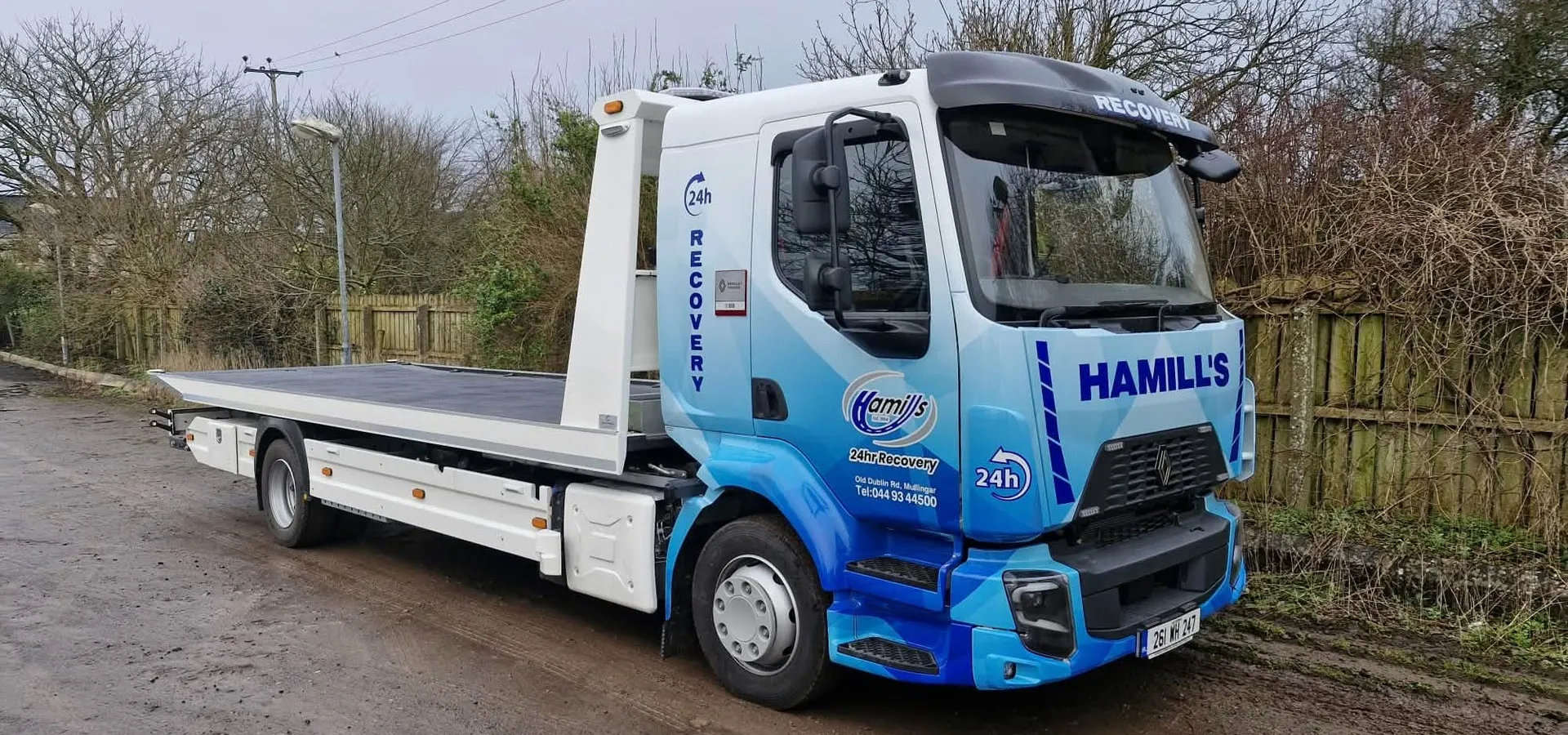
Recovery work lives on the road, most of it after dark. The truck is often the first thing a driver sees after a breakdown, so the livery has to do three jobs at once: look like a serious operator, give a phone number that can be read from a few metres away in weather or at dusk, and be seen by other traffic before headlights pick out the vehicle at all.
The brief
Hamill Group sent over a clear outline for each vehicle: colours, layout and branding requirements, plus specific instruction on where reflective text and decals had to sit to maximise roadside visibility. Night-time operation and roadside safety were treated as a design requirement from the start, not an add-on once the livery looked right. High-resolution photos of each cab came in ahead of design, so every wrap was cut to that vehicle’s actual panels, rivets and access doors, not a generic outline.
How we approached it
We built the design around a strong geometric field rather than a busy collage of photos. Large colour blocks hold up at speed, and the name and the 24-hour promise sit high and clear. Reflective decals were specified as part of the same artwork rather than stuck on afterwards, running along the sides and lower panels exactly where Hamill Group asked for them, so the truck stands out to oncoming traffic at the exact heights a driver’s eye and headlights actually catch.
Every proof went back to Hamill Group for review before a sheet of film was cut, with quick turnaround on any changes. Fitting happened in a controlled space so film could go down cleanly around channels and hardware, without rushing what should be a careful install.
On the road
The finished wrap reads as one piece of kit across the fleet: cab, body, markings and reflective elements all specified together. That consistency, day or night, is what customers remember when they need recovery at an awkward hour. The same artwork and approval process extends to new trucks as the fleet grows.
If you are briefing a similar job, bring the make, model and a few cab photographs, or bring the vehicle. We will tell you what the body can take, and where the reflective elements need to sit, before we talk about colour.